What I describe is common to validate, real, planned and requested column.
The duration seems to be only a integer (full day).
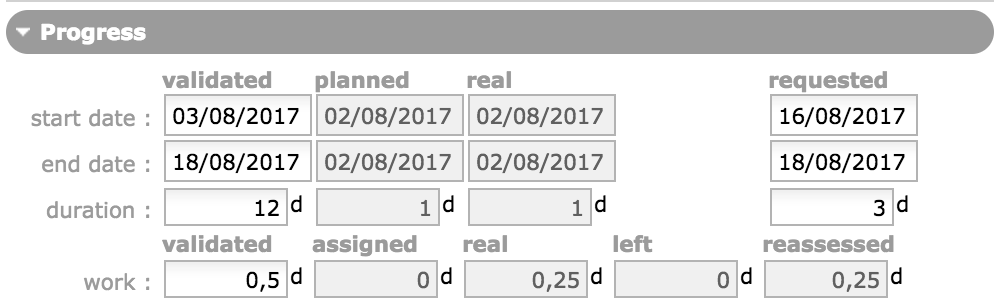
Let's say that I enter the following:
start date : 03/08/2017
end date: 18/08/2017
the duration is set to 12.
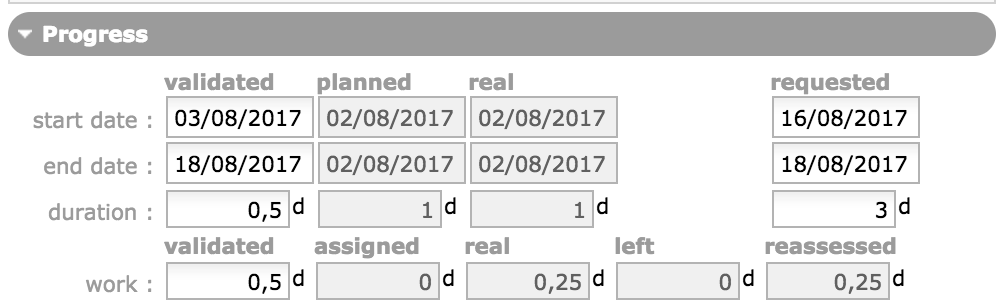
Now my activity is estimated for a duration of 0,5 day.
The end date does not update.
I can save the activity with no error or warning, but when I open it again, the original values are set:
start date : 03/08/2017
end date: 18/08/2017
the duration is set to 12.
Duration is always an integer, in days (it represent open days).
It is just the difference between end and start dates.
As ProjeQtOr does not manage hours in the day, you cannot define duration less than 1 day or not interger.
But this should not have impact on planning if you run work driven plannng (as expected on projeqtor).
I have to confess that "Work driven planning" is not as clear as I wish.
I tried to find information about it (Google!) without any success.
The only explanation of the concept I found is what you wrote here www.projeqtor.org/en/forum/9-tips-tricks...n-project-management
Is that approach, "only" the result of your own experience?
(By only I don't want to minimize it, just pointing out that more documentation is needed -at least by me ).
You may find information searching "effort driven" planning (it is how MS-Projects calls it), or "capacity" planning.
To set is short, you may have "duration driven" or "effort driven" :
in duration driven you fix the duration : then adding resources adds work
For instance, I must execute a task in one month. If I assign 1 resource, it costs 20 days.If I assign 2 resources, it costs 40 days. Duration is fixed (20 days)
in effort driven you fix the work required to execute the tasks ; then adding resources will determine duration
For instance, I must execute e task estimated at 40 work days. If I assign 1 resource, it will take 2 months, if I assigne 2 resource, it will take 1 month.
Only effort driven really gives capacity planning, because you give the real estimated workload to execute the task.
In duration driven, you don"t estimate the required effort (work) and you let your delays drive your planning : if you don't follow up very frequently every task, your will be always late because you won't see it assigned resources are enough to execute the task in given duration.
En poursuivant votre navigation, vous acceptez le dépôt de cookies tiers destinés au bon fonctionnement et à la sécurisation du site (gestion de session, reCaptcha) et à une analyse statistique anonymisée des accès sur notre site (Google Analytics). Si vous vous inscrivez, les informations que vous fournirez ne seront jamais divulguées à un tiers sous quelque forme que ce soit. En savoir plus
Paramétrages de cookies
×
Cookies fonctionnels
Ce site utilise des cookies pour assurer son bon fonctionnement et ne peuvent pas être désactivés de nos systèmes. Nous ne les utilisons pas à des fins publicitaires. Si ces cookies sont bloqués, certaines parties du site ne pourront pas fonctionner.
Session
Veuillez vous connecter pour voir vos activités!
Autres cookies
Ce site web utilise un certain nombre de cookies pour gérer, par exemple, les sessions utilisateurs.
 Supportez nous sur Capterra








 ).
).